
How Key-Swappable Modular Design Cuts After-Sales Costs by up to 80%
Why does a $50–$150 service call follow every conventional smart lock failure — and how does a patented key-swappable module turn it into a 10-second, do-it-yourself fix? This article breaks down the mechanism and the distributor economics behind up to 80% lower after-sales costs.中文摘要:传统智能锁每次故障都伴随 50–150 美元的上门售后成本。本文解析 TrueWay 原创钥匙换模块结构(右转开门、左转 90° 释放、10 秒内完成更换)如何把售后变成一次快递,帮助经销商把售后成本最多降低 80%。正文为英文。
The Hidden Cost Hiding in Every Conventional Smart Lock
Ask any experienced smart lock distributor what eats their margin, and the answer is rarely the purchase price. It is what happens after the sale. A conventional smart lock is an integrated unit: the electronics, the mechanics, and the exterior shell are one inseparable product. When anything electronic fails — a fingerprint sensor, a keypad, a card reader — the entire lock has to come off the door.
That single design decision creates a cost chain every distributor knows too well. A technician visit runs $50–$150 per incident. If the lock has to go back for repair, the door needs a temporary solution while the customer waits days, sometimes weeks, for parts or a replacement unit. Add return shipping, warranty processing, and the staff hours spent coordinating it all, and one service call can erase the profit on several units sold. For project installations with hundreds of doors, the math turns into a permanent service department.
One Key, Two Directions: How the Modular Design Works
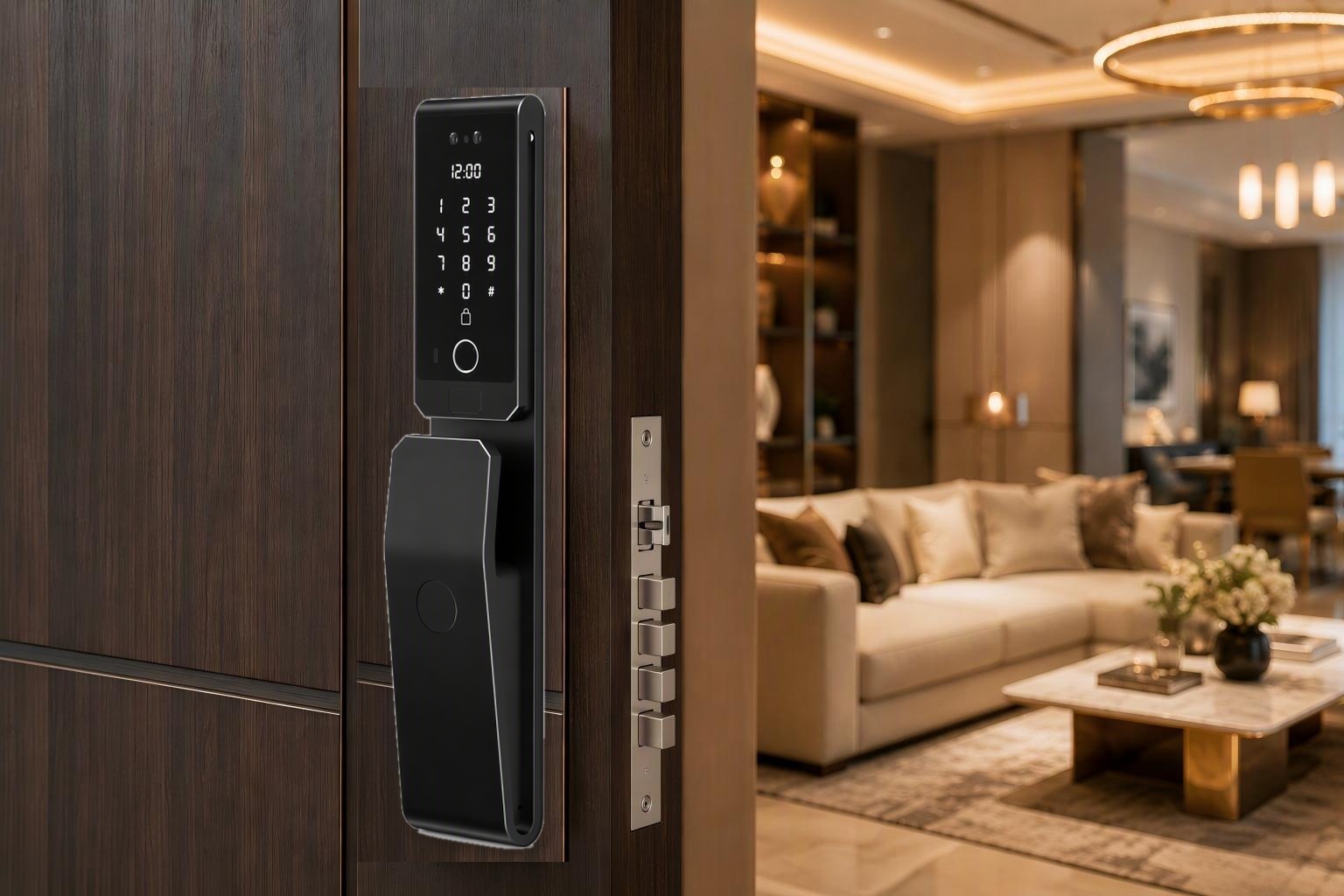
TrueWay was engineered to break that chain at its source. The lock is split into two parts: a permanent body that stays on the door, and a front-panel module that carries all the electronics. The two connect through a patented key-release mechanism protected in the United States (US 12,499,723 B1), Germany (DE202025001780), and China (CN201610502753).
The operation is deliberately simple. The same mechanical key used every day does two jobs: turn it right, and the door opens. Turn it left 90 degrees, and the front-panel module releases. A failed or outdated module comes off, a fresh one clicks in, and the key turns back to lock it in place. The whole swap takes under 10 seconds — no tools, no technician, and the lock body stays on the door throughout.
Notice what this does to the cost chain. There is no technician to dispatch, because the end user or on-site staff performs the swap. There is no lock removal, so there is no door downtime and no re-installation. There is no waiting for a whole replacement lock, because the spare part is a small module that fits in an envelope and ships by courier. The service cost per incident drops from $50–$150 to the price of postage.
Works Like Insurance for Every Lock You Sell
The most useful way to think about the key-swap mechanism is as insurance built into the hardware. It works like insurance for every lock you sell — invisible on good days, invaluable on bad ones. You hope you'll never need it. You'll be glad it's there.
On good days, nobody thinks about it. The lock opens, the customer is happy, and the module sits quietly doing its job. On bad days — a sensor failure at a rental property at 9 PM, a keypad issue in a hotel with a guest at the desk — the difference between a modular lock and an integrated one is the difference between a 10-second fix and a multi-day service event. Distributors do not buy the mechanism for the good days. They buy it so the bad days stop costing them money and reputation.
What the Numbers Mean for Distributors
Distributors running the TrueWay platform report up to an 80% reduction in after-sales costs. The savings come from three structural changes rather than one:
Service calls become parcels. Most electronic failures are resolved by mailing a module. The "service department" becomes a shelf of spare modules and a courier account.
Inventory collapses. One lock body accepts three module combinations — fingerprint + password + RFID, password + RFID, or RFID only. Instead of stocking three complete lock lines, distributors stock one body and a handful of small modules, which frees working capital and simplifies forecasting.
The installed base keeps paying. Every TrueWay body on a door is a future module sale. Customers who start with a keypad module later upgrade to fingerprint or to the RF-3's 3D face recognition — and the upgrade is a $15–$45 module purchase, not a new lock. Repeat revenue arrives without repeat installation cost.
The Takeaway
After-sales cost is not a service problem to be managed; it is a design problem to be eliminated. An original, patented key-swappable structure removes the technician, the lock removal, and the waiting from the equation — which is how after-sales costs fall by up to 80%, and why the same structure gives distributors stronger pricing power and lower support costs at the same time.
To see the mechanism in action, watch the product videos on the RF-1, RF-2, and RF-3 pages, or read the 57-question B2B FAQ library.
Questions about distributing TrueWay in your market?想了解在你的市场经销 TrueWay?